100+ Ideas To Choosing The Right Cut for Your Style, Hair Type, and Lifestyle
Men’s haircuts have become far more individual in recent years. The old idea that a man simply chooses between a short haircut, a medium haircut, or a longer style no longer reflects how modern barbering works. Today, the best haircut is usually built from several decisions: where the sides are tapered or faded, how much weight remains around the temples, how the top is textured, how the neckline is shaped, and how the finished cut fits the wearer’s daily routine.
That shift has also changed what men expect from a haircut. A style can be sharp without being extremely short. It can be fashionable without requiring complicated styling every morning. It can even combine contrasting ideas—such as a longer back with tightly controlled sides—to create something personal rather than simply copying a familiar trend.
Our approach to men’s hairstyles focuses on those details. Rather than treating a haircut name as a complete description, we look at the structure behind the style and how small changes affect the finished appearance. Our editorial guides examine current men’s hairstyles through proportions, texture, maintenance, barber communication, and everyday wearability.
That matters because two men can ask for the same haircut and walk away with very different results.
A high fade, for example, creates substantially more contrast than a low taper because the shortest section begins much higher on the sides. A low taper keeps more of the natural side profile intact, making it easier to combine with classic, textured, curly, or medium-length hairstyles. A modern mullet changes the equation again by making the relationship between the crown, sides, and back the defining feature.
The goal of this guide is not to declare one haircut the universal winner. Instead, it explains how to choose the right direction and how to communicate that choice to a barber.
Haircuts Are About Shape Before They Are About Trends
One of the biggest mistakes men make when choosing a haircut is starting with a photograph without considering the structure of their own hair.
A reference image is useful, but it does not automatically translate from one head to another. Hair density, growth direction, texture, cowlicks, crown behavior, forehead height, and natural volume can all change how a haircut appears.
A style that looks effortless on thick, wavy hair may require significantly more work on fine, straight hair. A dramatic fade that looks balanced on one head shape can expose too much side area on another. A long textured top can appear full on dense hair but much flatter on fine hair.
This is why experienced barbering is less about copying an image and more about interpreting it.
Before choosing a haircut, consider four questions:
- How much length do you actually want to maintain?
- Where do you want the strongest visual contrast?
- How much styling are you realistically willing to do?
- Do you want your natural texture to remain visible or controlled?
Those answers usually narrow the options much faster than simply browsing dozens of hairstyle photographs.
The Rise of More Personalized Men’s Haircuts
The current generation of men’s hairstyles is defined by customization.
Instead of one haircut being worn exactly the same way by everyone, barbers increasingly combine familiar techniques to create variations. A taper can be paired with a textured crop, curtains, a quiff, a slick back, or longer layers. A high fade can support curls, an Afro, a French crop, a pompadour, or a longer textured top.
The modern mullet is perhaps one of the clearest examples of this change. It no longer has to mean an exaggerated long tail and extremely short sides. It can be subtle, layered, tapered, curly, textured, or heavily faded.
Our current modern mullet guide demonstrates this flexibility with variations ranging from classic and tapered versions to burst fades, curly shapes, textured fringes, layered backs, and longer statement silhouettes.
The important lesson is that a haircut category is only the starting point.
The real style comes from the proportions.
Understanding the Difference Between a Taper and a Fade
The words “taper” and “fade” are often used interchangeably in casual conversation, but they can describe noticeably different visual results.
A taper generally concentrates the reduction of length around specific areas such as the sideburns and neckline. More of the surrounding hair remains intact. This creates a softer transition and allows the natural shape of the haircut to remain visible.
A fade usually creates a broader transition from longer hair into very short hair. The starting height of that transition can dramatically change the appearance.
This distinction is particularly important when choosing between a low taper and a high fade.
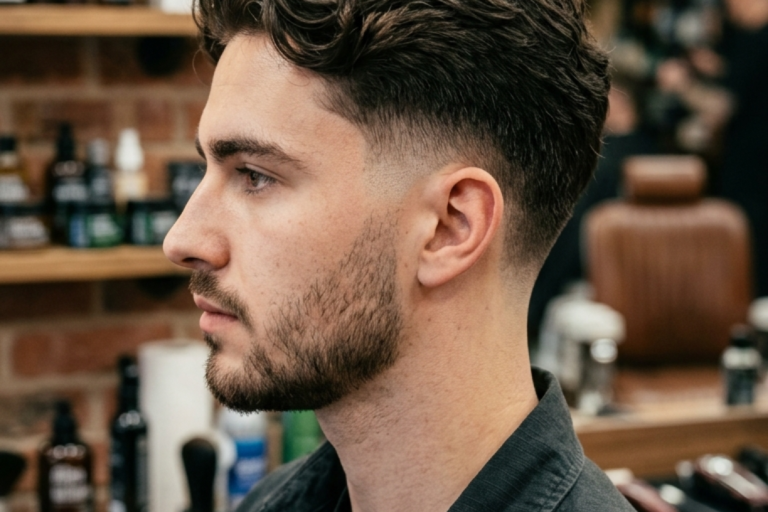
A low taper is usually more understated. It cleans up the edges without taking too much visual weight from the sides. This makes it an especially flexible Low taper trends . who want their haircut to work in professional, casual, and social environments.
A high fade makes a stronger statement. Because the blend begins higher, more weight is removed from the sides and attention is directed toward the hair on top.
Neither approach is automatically better.
The better option depends on how much contrast you want.
For men interested in seeing how a low taper can be adapted to different textures and hairstyles, Our Magazine’s detailed collection of low taper fade ideas covers variations including textured crops, curls, quiffs, slick backs, curtains, wavy hair, thick hair, straight hair, and beard combinations.
Why the Low Taper Remains So Versatile
The low taper has become one of the most adaptable choices in contemporary men’s grooming because it does not force the entire haircut into an aggressive silhouette.
The taper can remain concentrated around the ears, temples, and neckline while the top retains enough length to develop its own character.
That makes it particularly useful for men who change their styling from day to day.
The same low taper foundation can support a textured crop on Monday, a side-swept style for work, and a messier finish on the weekend. It can also work with naturally wavy or curly hair without requiring the sides to be taken extremely short.
The low taper is also forgiving during grow-out. Because the transition is concentrated in a smaller area, the haircut can remain visually balanced for longer than an aggressively faded style.
However, subtle does not mean careless.
The best low tapers depend on precision. If the taper is pushed too high, the haircut starts moving toward a different visual category. If too much weight is removed around the temples, the top can appear disconnected. If the neckline is allowed to grow without cleanup, the polished quality disappears.
A useful barber instruction is to explain what you do not want.
Instead of simply saying, “Give me a low taper,” tell the barber that you want the taper kept low around the temple and neckline and that you want to preserve weight through the upper sides.
That gives the barber a much clearer starting point.
When a High Fade Makes More Sense
There are situations where a low taper simply does not provide enough contrast.
If you want the hairstyle on top to dominate the silhouette, a high fade can be a better foundation.
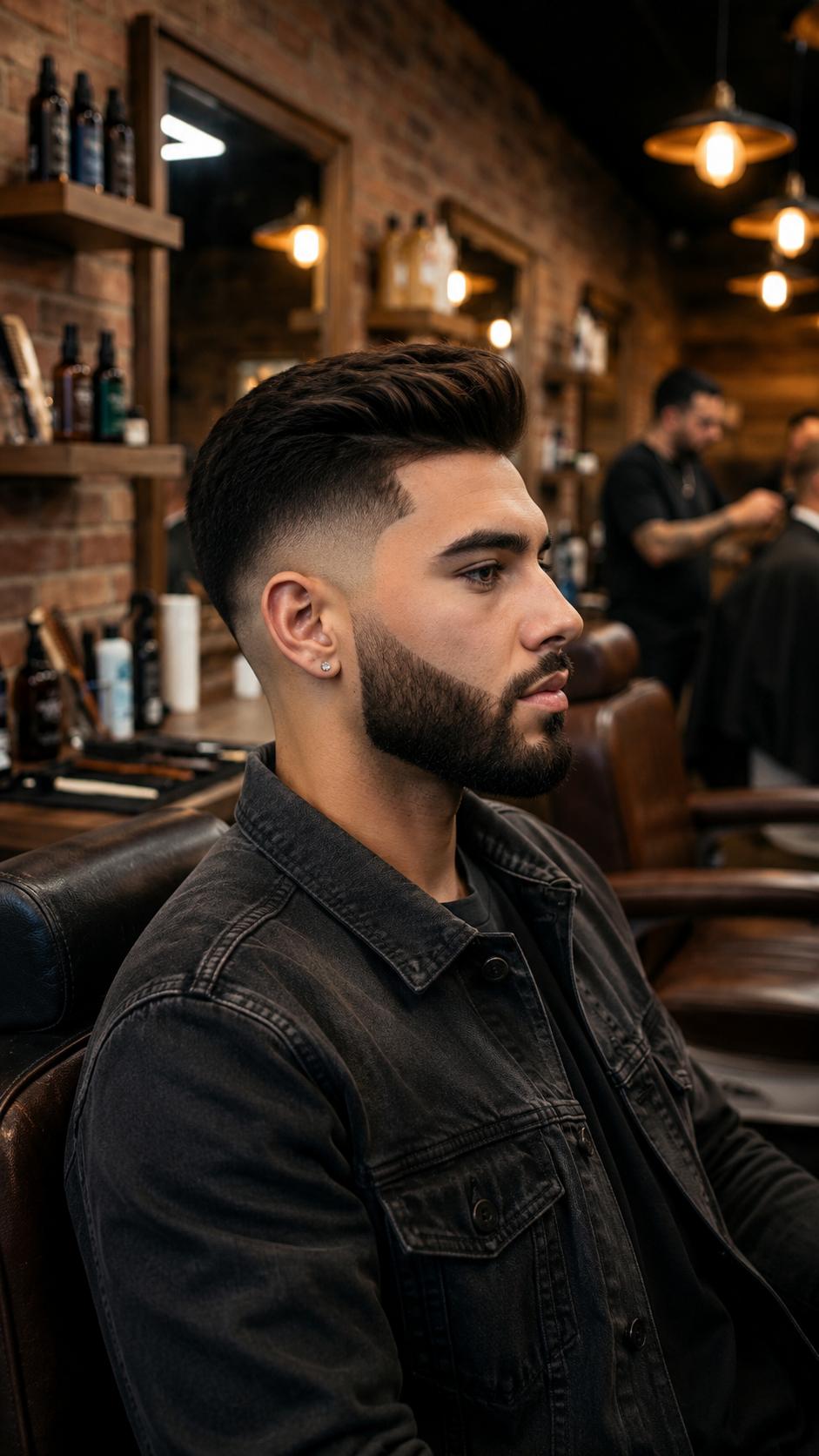
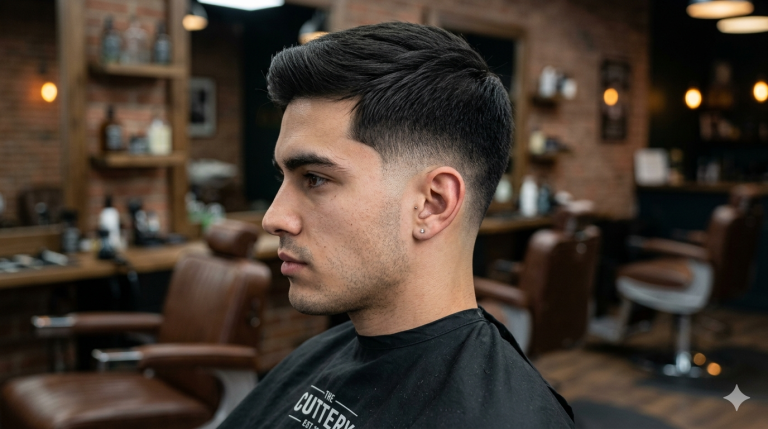
A high fade begins significantly higher on the sides and back, creating a sharper difference between the longer top and the closely blended areas. This makes the top look more prominent and can remove substantial bulk from dense hair.
This is particularly useful for hairstyles where volume, texture, or height is the main feature.
Consider a textured crop. The top needs enough definition to stand apart from the sides. A high fade creates that visual separation immediately.
The same principle applies to a pompadour or quiff. The height on top becomes more noticeable because the surrounding sides are significantly cleaner.
For curly or coily hair, the effect can be equally strong. Removing side bulk allows the natural texture on top to become the focal point.
The high fade guide explores variations ranging from classic and skin fades to textured tops, French crops, slick backs, quiffs, curly styles, thick hair, Afro-textured hair, and longer tops.
The key is understanding the trade-off.
More contrast generally means more maintenance.
As the fade grows, the change in length becomes noticeable quickly. Men who want a consistently crisp high fade may need more frequent barber visits than someone wearing a low taper.
The Modern Mullet Is a Different Kind of Decision
The modern mullet is not simply another variation of a fade.
Its defining feature is the relationship between the front, crown, sides, and back.
The back needs enough length to establish the silhouette, while the top and sides determine how dramatic or subtle that difference feels.
This is why a modern mullet can look completely different from one person to another.
A tapered mullet keeps the sides relatively soft and allows the back to become the main feature without an aggressive contrast. A burst fade mullet creates much more separation around the ears. A curly mullet uses natural volume to build the rear silhouette. A shaggy mullet relies on layers and movement instead of a clean geometric transition.
The most wearable versions often depend on restraint.
A common mistake is assuming that making the back longer automatically makes the mullet better. In reality, length without shape can become heavy and unbalanced.
The back needs to be shaped.
The crown needs to connect with it.
The sides need to support the silhouette rather than compete with it.
And the fringe or front section can completely change the personality of the haircut.
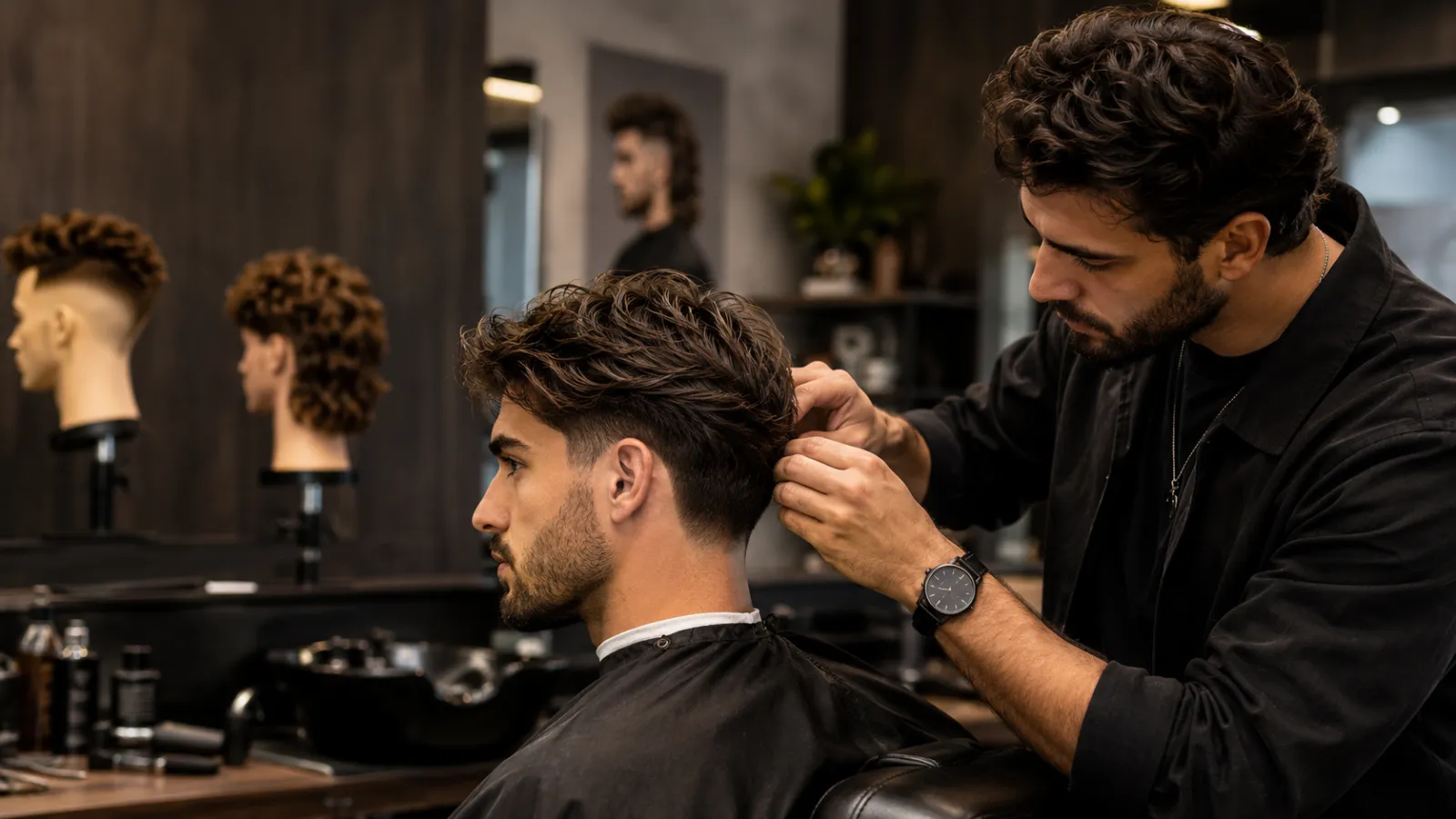
Our modern mullet editorial research emphasizes this broader approach, covering different lengths, textures, taper placements, fade combinations, layered shapes, fringes, and styling directions rather than treating the mullet as one fixed haircut.
For a deeper visual reference, see the full collection of modern mullet ideas
Choosing a Haircut According to Hair Density
Hair density is one of the most overlooked factors in haircut selection.
Two men can have the same hair length but completely different density.
Dense hair creates natural volume and can support stronger layering, longer tops, and textured shapes. But density can also create unwanted bulk around the sides.
This is where fades and tapers become useful.
A high fade can remove substantial side weight from dense hair, allowing the top to remain full without creating a wide silhouette.
A low taper takes a more conservative approach. It removes weight around the edges while preserving more of the natural side profile.
For men with medium-density hair, the priority is often maintaining enough weight to prevent the haircut from looking thin.
This means aggressive thinning is not always the answer.
A barber may be able to create movement through layering and point cutting instead of removing large amounts of internal weight.
Fine hair presents a different challenge.
The goal is often to create the appearance of density rather than simply reducing length. Heavy styling products can flatten fine hair, while excessive texturizing can make the top appear even thinner.
A shorter, textured top with a clean taper can work well because the haircut relies on shape rather than excessive length.
The right question is not, “Which haircut is best for thick hair?”
It is:
“What haircut uses my natural density to its advantage?”
Straight Hair Needs Movement, Not Always More Product
Straight hair is often considered easy to style, but its lack of natural bend can make certain shapes appear flat.
This is why modern straight-hair cuts frequently depend on layering, texture, and directional styling.
A low taper with a textured top can create movement without sacrificing length.
A high fade with a longer top can create a sharper contrast.
A modern mullet can use layering to prevent the back from falling into one heavy shape.
The important detail is how the top is cut.
If every strand is cut to nearly the same length, straight hair can become visually flat. Subtle variation allows the hair to separate naturally.
Styling should support that structure rather than replace it.
A lightweight matte cream or texture product is often more useful than a heavy, high-shine pomade when the goal is movement.
For a side-swept style, blow-drying in the desired direction can also create more lasting shape than simply adding more product.
Wavy Hair Should Usually Be Allowed to Behave Like Wavy Hair
Wavy hair already provides a natural styling advantage: movement.
The mistake is trying to remove that movement through excessive brushing, aggressive thinning, or heavy products.
A low taper works particularly well because it cleans the edges while leaving enough length for the natural wave to remain visible.
A textured crop can use the wave to create separation.
A modern mullet can use waves to give the back more movement without requiring dramatic layering.
Even a high fade can work if the goal is to make the textured top the central feature.
The haircut should be designed around the wave pattern.
That means a barber needs to understand how the hair behaves when dry, not just how it appears immediately after being wet.
This is especially important around the crown.
If the crown naturally pushes in one direction, cutting against that behavior can make everyday styling unnecessarily difficult.
Good barbering often means cooperating with the hair rather than constantly fighting it.
Curly and Coily Hair Require Different Thinking
Curly and coily hair cannot always be treated using the same cutting logic as straight hair.
Shrinkage changes apparent length. Curl patterns vary across the head. Density can be concentrated in specific areas. Moisture levels can change the finished shape.
A barber should therefore consider how the hair will look in its natural state.
A taper can clean the edges while preserving curl volume.
A high fade can create a strong frame around curls.
A modern mullet can allow the natural curl pattern to become the defining feature of the back.
The biggest mistake is judging the final haircut only by wet length.
Hair that looks long while wet can contract considerably when dry.
Likewise, excessive thinning can disrupt curl grouping and make the finished style look less controlled.
The goal should be shape, not simply reduced bulk.
For men with textured hair, the conversation with the barber should include how much curl or coil you want to preserve, how short the sides should become, and whether the top should remain rounded, layered, cropped, or elongated.
Face Shape Matters—but It Should Not Control Everything
Face-shape advice is useful when treated as a guideline rather than a rule.
Oval faces generally offer considerable flexibility because the proportions are relatively balanced.
Rounder faces can benefit from hairstyles that create height or reduce excessive width at the sides.
Square faces can carry structured cuts well because the natural jawline already provides strong definition.
Longer or oblong faces may benefit from avoiding excessive height while preserving some side movement.
But hair texture and personal style still matter.
A man with a round face does not automatically need an extremely short fade.
A man with a square face does not automatically need a rigid, structured haircut.
The best result comes from balancing several factors at once.
For example, a low taper can preserve enough side weight to soften the overall silhouette, while a textured top can add direction without excessive height.
A high fade can produce the opposite effect by reducing side width and emphasizing the top.
A modern mullet can alter the visual balance through length at the back rather than height at the top.
The haircut should serve the entire appearance rather than follow a single face-shape rule.
Think About Your Daily Routine Before Choosing a Haircut
A haircut can look incredible in a photograph and still be the wrong choice for everyday life.
This happens when the photograph represents a heavily styled finish that the wearer cannot realistically reproduce.
Before choosing a haircut, consider how much time you spend getting ready.
If you have two minutes in the morning, a high-volume pompadour may become frustrating.
If you enjoy styling your hair every morning, a longer textured top opens up more possibilities.
If you work in an environment where conservative grooming is expected, a low taper or classic textured cut may provide more flexibility than an extreme fade or dramatic mullet.
If you travel frequently, a haircut that grows out neatly may be more practical than one that requires weekly precision.
Maintenance is part of the haircut.
A style that only looks good for three days after a barber visit is not necessarily a practical style.
How Often Should You Visit the Barber?
There is no universal schedule because different haircut structures reveal growth at different rates.
A high skin fade can lose its crisp contrast quickly.
A low taper can remain visually acceptable for longer because more of the surrounding hair remains intact.
A textured medium-length style may continue to look intentional as it grows.
A modern mullet may actually become more interesting during part of its grow-out, provided the layers and proportions were designed correctly.
Instead of choosing appointments based on a fixed calendar, look at the haircut itself.
If the taper has disappeared, the neckline has become untidy, or the fringe is interfering with your eyes, it is probably time for maintenance.
Men who prefer very precise fades may choose frequent appointments.
Men with longer or softer hairstyles can often stretch the time between cuts.
The Barber Consultation Is More Important Than the Haircut Name
One of the most useful improvements a man can make is learning how to describe what he actually wants.
Simply saying “high fade” or “modern mullet” leaves many details unresolved.
A better consultation includes:
- The desired length on top
- The preferred fade or taper height
- How much length should remain at the back
- Whether the neckline should be natural, tapered, or squared
- How much texture should be removed
- Whether the fringe should be blunt or textured
- How much styling is acceptable
- What parts of the reference image you specifically like
You can also explain what you dislike.
For example:
“I like the top and back of this reference, but I don't want the sides taken this high.”
That sentence can prevent a major misunderstanding.
Another useful instruction is:
“Keep the shape natural when it grows out.”
This tells the barber that your priority is not only the fresh-cut appearance but also the haircut’s behavior several weeks later.
Bring a Reference—but Explain the Reference
A photograph is helpful because haircut terminology can mean different things to different people.
However, do not assume the barber will automatically understand which element of the image you want copied.
Point out the details.
“I like this amount of texture.”
“I want the back length from this picture.”
“I prefer the softer taper from this one.”
“I don't want the fade to go this high.”
This approach turns several photographs into useful information rather than creating confusion.
You can even combine references from different styles.
For example, you might want the top texture from a textured crop, the side treatment from a low taper, and the back shape of a modern mullet.
That is completely reasonable when the barber understands the intended proportions.
Modern barbering is built around this kind of customization.
Avoid Choosing a Haircut Only Because It Is Trending
Trends are useful for discovering new ideas, but they should not be the final deciding factor.
A haircut becomes valuable when it works for the person wearing it.
If a trend requires a texture your hair does not naturally have, you may spend too much time styling it.
If it requires frequent maintenance you cannot commit to, it will quickly stop looking like the reference.
If the proportions fight your natural head shape, the result may feel uncomfortable even if the haircut itself is technically fashionable.
This is why a slightly modified version of a trend can often look better than an exact copy.
The most successful modern hairstyles are rarely identical from person to person.
The Importance of the Back and Side Profile
Men often judge their haircut from the front because that is the angle they see most often.
But the side and back profile can determine whether the haircut actually looks balanced.
This is especially important for mullets, longer tops, fades, and taper combinations.
A haircut can look excellent from the front while becoming too heavy around the crown.
A fade can look clean from one side but sit too high on the opposite side.
A longer back can appear balanced straight on but look disconnected from the side.
Ask your barber to show you the haircut from multiple angles before the final styling.
This gives you an opportunity to catch proportion issues while they can still be corrected.
It also helps you understand what the haircut will look like to other people.
The Neckline Is a Small Detail With a Large Effect
The neckline is one of the easiest details to overlook.
Yet it can influence the entire impression of a haircut.
A clean tapered neckline creates a softer transition and often works well with modern fades and longer hairstyles.
A squared neckline creates a more defined edge.
A natural neckline allows the hair to follow its own growth pattern and can produce a less manufactured appearance.
The correct choice depends on the haircut.
A modern mullet may require a neckline that supports the longer back rather than cutting across it too aggressively.
A low taper can use a soft neckline to maintain its understated character.
A high fade can benefit from a crisp lower finish because the rest of the haircut already relies on strong contrast.
These details are why haircut photographs alone do not tell the entire story.
Styling Should Enhance the Cut, Not Hide It
Good styling should make the haircut easier to understand.
If a haircut only works after applying a large amount of product, there may be a structural problem.
Modern men’s hairstyles increasingly favor natural movement.
Matte clays, texture creams, sea salt sprays, curl creams, and lightweight styling products can help create definition without making the hair appear overly manufactured.
The correct product depends on the hair.
Fine hair generally benefits from lightweight products.
Thick hair may need stronger control.
Curly hair usually benefits from products designed to preserve moisture and definition.
Wavy hair often responds well to lightweight texture products.
The application method matters as well.
Putting too much product directly onto the roots can flatten the hair.
Instead, start with a small amount and add more only if necessary.
This is particularly important for styles such as quiffs, pompadours, and textured crops where excessive product can destroy the movement that makes the haircut attractive.
What Makes a Haircut Look Modern in 2026?
There is no single feature that defines a modern haircut.
Instead, current styles tend to share several characteristics.
First, they are adaptable.
Second, they usually work with natural texture rather than trying to eliminate it.
Third, they use contrast intentionally.
Fourth, they pay attention to proportions.
And finally, they are increasingly personalized.
A modern haircut does not necessarily need a dramatic fade.
It might be a softly tapered style with a textured top.
It might be a longer layered haircut with a clean neckline.
It might be a mullet with subtle sides.
It might be a high fade with natural curls.
What makes it contemporary is the way the elements are combined.
Three Strong Directions for Men Choosing a New Style
If you are currently unsure where to start, three broad directions cover a large portion of modern men’s haircut preferences.
The Subtle Direction: Low Taper
Choose a low taper if you want a clean edge while preserving more of your natural hair.
It is especially useful when versatility and grow-out matter.
You can keep the top short, medium, textured, curly, wavy, or relatively long.
The taper acts as the supporting structure rather than becoming the dominant feature.
The Bold Direction: High Fade
Choose a high fade if you want contrast.
It is ideal when you want the top to become the visual centerpiece.
It works especially well with textured, curly, high-volume, and structured hairstyles.
The trade-off is maintenance.
The stronger the contrast, the more obvious growth becomes.
The Creative Direction: Modern Mullet
Choose a modern mullet if you want the haircut itself to have a distinctive silhouette.
It is less about simply keeping the back long and more about controlling the relationship between the top, sides, crown, and rear length.
The style can be subtle or dramatic depending on the taper, fade, layering, and back length.
A Practical Way to Choose Your Next Haircut
Instead of opening a gallery and randomly selecting an image, use a five-step process.
First, decide your maximum daily styling time.
Second, identify your natural hair texture and density.
Third, decide whether you want subtle, medium, or strong contrast around the sides.
Fourth, determine whether you want the haircut to look traditional, contemporary, or deliberately experimental.
Finally, show your barber one or two strong references and explain which elements you want to preserve.
This process removes much of the uncertainty.
You are no longer asking, “Which haircut looks coolest?”
You are asking, “Which haircut fits the way I actually live?”
That is a much better question.
Final Perspective
Men’s haircuts in 2026 are less about following one universal trend and more about understanding how barbering techniques can be combined. But Maneva Magazine gives all types of experience with better ideas and knowledge.
A low taper offers subtle structure and versatility.
A high fade creates stronger contrast and emphasizes the top.
A modern mullet changes the silhouette through controlled length and layering.
None of these is automatically the best choice.
The strongest haircut is the one that respects your natural texture, works with your face and head shape, fits your maintenance routine, and can be communicated clearly to your barber.
That is also why reference images should be treated as starting points rather than instructions. The best result may be a modified version of the haircuts you originally intended.
A well-chosen haircut does more than follow a trend. It should make sense when you leave the barbershop, when you style it the next morning, and several weeks later when the haircut begins to grow out. That balance between appearance, practicality, and individuality is what turns a popular haircut into the right haircut for you.
Marcus Lyedo
Men's Hairstyles Expert
Welcome to Urban Gentify, where grooming meets confidence and style meets simplicity. Whether you're searching for the best haircut, trying to grow your hair faster, shaping the perfect beard, or upgrading your fashion game — you're in the right place.
Related Posts