Master the Fade. Own the Look

Toggle menu Logo
Home Blog Men Men's Hairstyles Fade Haircuts

Fade Haircuts

Discover the complete guide to men's fade haircuts. Explore low, mid, high, drop, burst, and skin fades. Learn how master barbers blend guard lengths seamlessly, match fades to face shapes, and maintain razor-sharp perimeter lines.

All Posts on Fade Haircuts

Marcus

100+ Ideas To Choosing The Right Cut for Your Style, Hair Type, and Lifestyle

Men’s haircuts have become far more individual in recent years. The old idea that a man simply chooses between a short h...

Read More about 100+ Ideas To Choosing The Right Cut for Your Style, Hair Type, and Lifestyle
Aug 24, 2026 | 0 Comments
Muhammad

Common Low Taper Fade Mistakes and How to Avoid Them

The low taper fade looks straightforward from the outside — clean sides, subtle transition, natural finish. But getting...

Read More about Common Low Taper Fade Mistakes and How to Avoid Them
Jul 29, 2026 | 0 Comments
Muhammad

Low Taper Fade with Beard for Black Men: Best Styles and Grooming Tips

A low taper fade paired with a beard has been a barbershop staple for years, and for good reason. The clean sides, the n...

Read More about Low Taper Fade with Beard for Black Men: Best Styles and Grooming Tips
Jul 29, 2026 | 0 Comments
Muhammad

Low Taper Fade Styles for Wavy Hair

Wavy hair has its own personality. It moves on its own, holds texture without much effort and generally looks better whe...

Read More about Low Taper Fade Styles for Wavy Hair
Jul 29, 2026 | 0 Comments
Muhammad

Low Taper Fade for Summer: Stay Cool and Look Sharp

Summer is brutal on hair. Heavy styles that looked great in winter suddenly feel suffocating once the heat kicks in — sw...

Read More about Low Taper Fade for Summer: Stay Cool and Look Sharp
Jul 29, 2026 | 0 Comments
Muhammad

Low Taper Fade Styles for Straight Hair: Best Haircuts for Men

Straight hair and a low taper fade go hand in hand. The smooth, flat texture of straight hair makes the fade look crisp...

Read More about Low Taper Fade Styles for Straight Hair: Best Haircuts for Men
Jul 29, 2026 | 0 Comments
Muhammad

Low Taper Fade with Buzz Cut: Best Styles, Guard Sizes & Barber Tips

A low taper fade with buzz cut is one of the easiest men’s hairstyles to manage right now. It keeps the hair short and s...

Read More about Low Taper Fade with Buzz Cut: Best Styles, Guard Sizes & Barber Tips
Jul 29, 2026 | 0 Comments
Muhammad

Low Taper vs Burst Fade: Which Haircut Looks Better on You?

Haircuts today are not just about looking clean. They also show personality, style and confidence. Two of the most talke...

Read More about Low Taper vs Burst Fade: Which Haircut Looks Better on You?
Jul 29, 2026 | 0 Comments
Muhammad

Low Taper vs Drop Fade: Which One Looks Better on You?

People often confuse low tapers with drop fades, even though both cuts have clear differences. Yeah, both cuts keep the...

Read More about Low Taper vs Drop Fade: Which One Looks Better on You?
Jul 29, 2026 | 0 Comments
Muhammad

Low Taper Fade for Wedding: The Best Groom Hairstyles to Try

Most guys spend months sorting out their wedding look. The sherwani or suit gets finalized early. Shoes get picked. Acce...

Read More about Low Taper Fade for Wedding: The Best Groom Hairstyles to Try
Jul 29, 2026 | 0 Comments
Muhammad

Low Taper Fade with Faux Hawk: The Bold Yet Clean Look Worth Trying

Some haircuts blend in. Others make a quiet statement without shouting. The low taper fade with a faux hawk sits firmly...

Read More about Low Taper Fade with Faux Hawk: The Bold Yet Clean Look Worth Trying
Jul 29, 2026 | 0 Comments

Men's Fade Haircuts Guide: Low, Mid, High & Skin Fade Styles

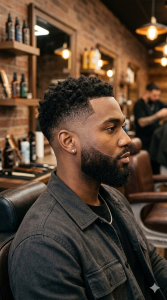
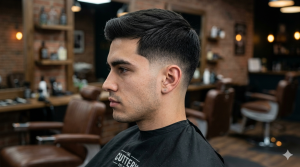
The fade haircut is the undisputed cornerstone of modern men's barbering. Defined by a continuous, seamless graduation of hair length from short or bare skin near the hairline up into longer density on top, a fade provides unmatched contrast, structure, and sharpness. A masterfully executed fade slims the face, emphasizes jawline angularity, and complements virtually any top hairstyle—including textured crops, pompadours, buzz cuts, quiffs, and curls. However, executing a flawless fade is a technical craft that demands millimeter precision, clipper lever control, and grain mapping. This definitive guide explores all fade classifications (Low, Mid, High, Drop, Burst, Skin), clipper guard mathematics, face shape compatibility, and professional maintenance cadences.

Historical Evolution and Cultural Context

The fade originated in the United States military during the 1940s and 1950s, where strict regulations required clean, tapered hairlines. During the 1980s and 1990s, Black and Latino barbers in urban cultural hubs transformed fading into an artistic movement, pioneering high-top fades, temple tapers, and razor-sharp edge-ups. The explosion of social media and modern cordless clipper technology in the 2010s propelled the fade into a global phenomenon. Today, the fade is a universal men's grooming standard worn across corporate boardrooms, sports stadiums, and high-fashion runways worldwide.

Key Styles, Cut Anatomy, and Variations

Fade haircuts are categorized by their starting elevation and contour path:

  • Low Fade: Begins just above the ears and neckline, keeping most of the sides dark and full. Subtle, conservative, and universally professional.
  • Mid Fade: Transitions at the temple and midway down the skull, creating noticeable contrast and balanced proportions for medium-length top styles.
  • High Fade: Starts high near the crown and temples, dropping down rapidly. High-contrast, bold, and athletic, accentuating strong cheekbones.
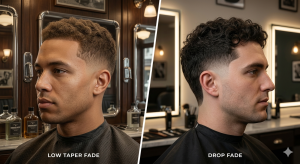
  • Drop Fade: Curves downward behind the ear to follow the natural contour of the occipital bone at the back of the head.
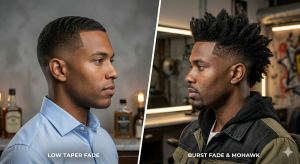
  • Burst Fade: Radiates in a circular pattern around the ear, leaving length at the back for faux hawks and modern mullets.
  • Skin / Bald Fade: Tapers down to absolute bare skin (00000 or foil shaver), delivering the cleanest, highest-contrast finish.

Face Shape and Hair Texture Compatibility Matrix

Selecting the optimal haircut requires understanding how hair density, curl pattern, and cranial bone structure interact:

Fade Type Elevation Point Best Paired Top Styles Maintenance Schedule
Low Fade 0.5 inch above ears/neck Side part, pompadour, classic scissor cut Every 2 – 3 weeks
Mid Fade Temple / mid-ear level Textured crop, modern quiff, crew cut Every 1.5 – 2 weeks
High Fade Above temples / near crown Buzz cut, high-and-tight, slick back Every 1 – 2 weeks
Drop Fade Curves below occipital bone Textured crop, messy fringe, afro Every 2 weeks
Burst Fade Circular radius around ear Mohawk, faux hawk, modern mullet Every 2 weeks

Step-by-Step Styling and Barber Execution Protocol

Follow this sequential framework to achieve salon-quality styling and structural hold at home:

  1. Establish the Baseline Guideline: The barber creates the lowest baseline using a trimmer or bare blade, establishing where the shortest length sits.
  2. Clear the Bulk: The sides and back are debulked using a larger guard (e.g., #2 or #3) up to the parietal ridge.
  3. Step-by-Step Guard Graduation: The barber transitions between guards in 1/2-inch increments (#0.5, #1, #1.5) using the clipper lever to open and close blade gaps.
  4. Feathering the Seams: Using an upward wrist flick ('C-motion'), the barber blends harsh lines between guards seamlessly.
  5. Clipper-Over-Comb Blending: A flat barber comb connects the side fade into the longer top hair along the parietal ridge.
  6. Razor Line-Up: A straight razor or zero-gapped trimmer etches crisp geometric lines along the temples, sideburns, and neck.

Essential Products, Formulations, and Styling Tools

Mastering hair texture requires the proper combination of pre-stylers, finishing clays, and professional tools:

Executing a world-class fade requires specialized barber clippers and finishing instruments:

  • Adjustable Magnetic Clippers: Features micro-taper levers that adjust cutting blade depth from 0.5mm to 2.5mm.
  • Half-Guards (#0.5 & #1.5): Crucial for erasing stubborn demarcation lines between bare blades and #1/#2 guards.
  • Hypoallergenic Foil Shaver: Cleans the lowest portion of skin fades down to baby-smooth skin without razor burn.
  • Cooling Blade Disinfectant Spray: Keeps clipper blades cool, lubricated, and sanitized during intense cutting.

Professional Barbershop Secrets and Edge Precision

Incorporate these master barber techniques to maintain clean contours and sharp graduation between appointments:

Master barbers utilize the 'Corner-Blade Technique': when blending small uneven spots or dark density shadows, they tilt the clipper so only the outer 3 to 4 teeth of the blade touch the hair. This micro-feathering erases dark weight lines without cutting into the surrounding fade.

Common Haircut Mistakes and How to Avoid Them

Avoid these frequent styling pitfalls that compromise hair health and visual balance:

  • Taking the Fade Too High: Rushing a mid fade too high near the crown creates a harsh, unbalanced 'mushroom' top.
  • Visible Step Lines: Failing to use half-guards leaves distinct horizontal lines where guard sizes changed.
  • Fading Against Skull Irregularities: Ignoring natural skull bumps creates uneven dark spots; use visual blending to maintain a uniform gradient.
  • Neglecting Neck Taper Touch-Ups: Allowing neck hair to grow unkempt ruins an expensive fade in under a week.

Seasonal Care and Maintenance Cadences

Environmental fluctuations impact hair cuticle hydration and scalp sebum production. Adapt your regimen across seasons:

In summer, high bald fades keep you cool and manage sweat during workouts. In winter, low taper fades preserve warmth while keeping your neckline clean and professional under heavy coat collars.

Barbershop Communication, Terminology, and Consultation Guide for Fade Haircuts

Achieving your ideal haircut requires clear, precise communication with your master barber. Never rely solely on generic names like 'short back and sides' or 'medium fade,' as barber interpretations vary widely. When requesting fade haircuts, specify exact guard numbers (e.g., '#1 closed tapering into a #2 on the temples'), define your preferred neckline finish (tapered vs. squared vs. rounded), state whether you want scissor texture or point-cutting on top, and bring two or three high-resolution reference photographs displaying the front, side profile, and back angles. An expert barber will assess your hair growth whorls, cowlicks, temporal recession, and skull geometry to customize the perimeter boundaries to your unique anatomy.

Blow-Drying Mechanics, Directional Airflow, and Pre-Styling Chemistry

Eighty percent of any great hairstyle’s volume, texture, and structural direction is established during the initial blow-dry rather than by finishing products alone. Apply a heat-activated pre-styler—such as a mineral sea salt spray or lightweight grooming tonic—to clean, towel-damp hair. Use a vented tunnel brush or round boar-bristle brush while blow-drying on medium heat, directing the airflow from roots to tips in the natural direction of desired hair flow. Maintain the dryer nozzle at a 45-degree angle approximately three inches from the hair to avoid scorching the keratin cuticle. Conclude the blow-dry with a 10-second blast of cold air (the 'cool shot' button) to contract the cuticle layer, lock the volume in place, and impart natural shine.

Scalp Health, Follicular Longevity, and Trimming Schedules

Healthy, vibrant hair requires an optimal scalp environment. The human scalp contains over 100,000 hair follicles that produce natural protective sebum. To prevent sebum buildup, follicular inflammation, and fungal flaking (Malassezia), wash your hair two to three times weekly with a sulfate-free botanical cleanser, massaging the scalp with circular fingertip pressure to stimulate microvascular perfusion. Schedule precision maintenance trims according to your style's requirements: short fades and precision line-ups require touch-ups every two weeks, classic crew cuts and tapers every three to four weeks, and medium-to-long textured flow styles every six to eight weeks to eliminate split ends and maintain clean geometric proportions.

Summary and Personal Aesthetic Philosophy

Your hairstyle is the primary architectural frame of your face and the most visible expression of your personal aesthetic. By understanding your facial geometry, selecting the proper cut, investing in quality styling products, and maintaining regular barber appointments, you project an enduring aura of confidence, grooming discipline, and effortless style.

Frequently Asked Questions

Got questions? We've got answers. Explore our most asked questions about fade haircuts.

A low fade begins just above the ears; a mid fade starts at temple level; and a high fade starts near the crown, creating bold, high-contrast sides.

A skin fade tapers all the way down to bare skin at the lowest point using a foil shaver or razor, while a regular fade tapers down to very short stubble (#0 or #0.5).

Skin fades look best when touched up every 1 to 2 weeks. Low and mid fades maintain their structure for 2 to 3 weeks before losing their sharp gradient.

A mid or high skin fade is ideal for round faces because taking the sides tight slims the cheeks and visually elongates the facial silhouette.

A drop fade is a fade that curves downward behind the ear, following the natural curve of the occipital bone rather than running in a straight horizontal line.

Specify where you want the fade to start (low, mid, or high), whether you want skin or stubble at the bottom, and bring a reference photo of the top style.