Master the Fade. Own the Look

Toggle menu Logo
Home Blog Men Men's Hairstyles Curly Hairstyles

Curly Hairstyles

Discover the ultimate guide to men's curly hairstyles. Learn how to care for, cut, and style curly hair types (2A to 4C). Explore curly fades, textured crops, curly fringes, and essential hydration routines to eliminate frizz and define natural curls.

All Posts on Curly Hairstyles

Muhammad

Hispanic Low Taper Fade Styles (Clean & Modern Guide)

A low taper fade is one of the cleanest and most popular haircuts among Hispanic men. It looks sharp without being loud...

Read More about Hispanic Low Taper Fade Styles (Clean & Modern Guide)
Jul 27, 2026 | 0 Comments
Muhammad

Low Taper Fade for Curly Hair: A Simple Style Guide for Men

A low taper fade curly hair style keeps your hair neat while showing your natural curls.It works well for kids, teens an...

Read More about Low Taper Fade for Curly Hair: A Simple Style Guide for Men
Jul 27, 2026 | 0 Comments

Men's Curly Hairstyles Guide: Haircuts, Care & Anti-Frizz Tips

Men's curly hair possesses natural volume, dynamic texture, and effortless character that straight hair simply cannot replicate. However, managing natural curls requires an understanding of curl physics, cuticle moisture dynamics, and specialized haircut geometry. Due to the elliptical cross-section of curly hair shafts, natural scalp sebum struggles to travel down the spiral fiber, making curls inherently drier, more porous, and highly sensitive to humidity and frizz. When cut improperly or stripped with harsh sulfate shampoos, curls become an unruly, unmanageable halo. Conversely, when sculpted with precision layering and nourished with hydrating curl creams, curly hair becomes a show-stopping asset. This definitive guide covers curl classification (Types 2A to 4C), modern haircuts (curly fades, crops, and fringes), diffuser drying mechanics, and anti-frizz product regimens.

Historical Evolution and Cultural Context

Curly hair has represented natural vitality and distinction throughout history. In classical Greek and Roman sculpture, gods and heroes like Apollo and Hercules were depicted with voluminous, cascading curls as emblems of divine strength and youth. In the 18th century, European aristocrats spent fortunes on curled powdered wigs to emulate natural curl volume. The late 20th century saw the emergence of iconic curly styles—from the soulful afros of the 1970s to the textured curls of 1990s hip-hop and R&B icons. Today's men's curly hair movement embraces natural hair acceptance, utilizing precision taper fades and curl-enhancing botanical leave-ins to celebrate authentic texture.

Key Styles, Cut Anatomy, and Variations

Modern curly hairstyles harmonize natural volume on top with clean, tapered sides:

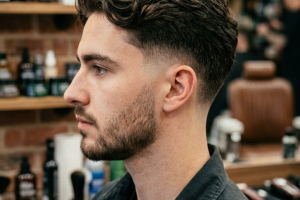
  • The Curly Taper Fade / Skin Fade: The most popular contemporary style. Blends the sides down to skin level while leaving full, bouncy curl volume on top, creating sharp contrast.
  • The Curly Textured Fringe: Hair is styled forward over the forehead in defined curl clusters with faded temples, providing youthful, modern face framing.
  • The Curly Undercut: Disconnects long top curls from tightly clipped sides, allowing curls to drape naturally over the crown with bold distinction.
  • Medium to Long Curly Flow: Shoulder-length layers that allow natural 3A/3B curls to cascade freely, styled with leave-in curl creams and wide-tooth combs.

Face Shape and Hair Texture Compatibility Matrix

Selecting the optimal haircut requires understanding how hair density, curl pattern, and cranial bone structure interact:

Curl Pattern Type Visual Characteristics Optimal Haircut Styles Essential Product Formulation
Type 2 (Wavy: 2A–2C) Loose 'S' waves, moderate volume Textured crop, messy quiff, mid taper Sea salt spray + lightweight matte paste
Type 3 (Curly: 3A–3C) Defined springy spirals, high volume Curly high fade, textured forward fringe Leave-in curl defining cream + argan oil
Type 4 (Coily / Afro: 4A–4C) Tight zig-zag coils, high density High top fade, drop fade afro, sponge twists Deep shea butter cream + scalp oil

Step-by-Step Styling and Barber Execution Protocol

Follow this sequential framework to achieve salon-quality styling and structural hold at home:

  1. Wash with a Hydrating Co-Wash: Replace daily shampoo with a nourishing cleansing conditioner (co-wash) 2 to 3 times weekly to cleanse without stripping natural lipids.
  2. Detangle Exclusively on Soaking Wet Hair: Never brush dry curls. Apply conditioner in the shower and detangle gently using a wide-toothed comb or your fingers from tips to roots.
  3. Apply Leave-In Curl Cream: Rake a quarter-sized amount of curl-defining cream through soaking wet hair, scrunching upward toward the scalp to encourage natural curl clumping.
  4. Microfiber Towel Scrunching: Gently squeeze excess water out with a microfiber towel or cotton t-shirt. Never rub, which disrupts curl formation and causes instant frizz.
  5. Air Dry or Diffuse on Low Heat: Allow curls to air dry naturally, or attach a bowl diffuser to your blow dryer, setting it to low heat and speed while cupping curls upward.

Essential Products, Formulations, and Styling Tools

Mastering hair texture requires the proper combination of pre-stylers, finishing clays, and professional tools:

Caring for natural curls requires moisture-rich formulations and curl-specific tools:

  • Leave-In Curl Defining Creams: Formulated with shea butter, flaxseed extract, and coconut oil to coat the cuticle, seal moisture, and lock in spiral definition.
  • Wide-Tooth Wooden Combs: Detangles knots smoothly in the shower without snapping fragile curly strands.
  • Bowl Diffuser Attachment: Disperses blow-dry airflow across a broad surface, drying curls gently without blowing them apart into frizz.
  • Mulberry Silk Pillowcases: Prevents overnight friction, allowing you to wake up with intact, tangle-free curls.

Professional Barbershop Secrets and Edge Precision

Incorporate these master barber techniques to maintain clean contours and sharp graduation between appointments:

Master curly hair barbers use the 'Dry Cutting / DevaCut' technique: cutting curly hair while it is 100% dry in its natural resting state. Because every curl has a unique shrinkage rate (often shrinking 30% to 50% from wet to dry), cutting dry ensures your barber sees the exact silhouette and length as it will appear every day.

Common Haircut Mistakes and How to Avoid Them

Avoid these frequent styling pitfalls that compromise hair health and visual balance:

  • Brushing Curls When Dry: Brushing dry curls destroys the natural curl clumps, instantly creating a frizzy, poofy afro.
  • Using High-Alcohol Styling Gels: Alcohol dries out already moisture-deprived curls, causing crunchiness and severe flaking.
  • Washing Daily with Sulfate Shampoo: Strips essential sebum, leaving curls brittle, dull, and prone to breakage.
  • Rubbing Hair with Rough Cotton Towels: Rough cotton loops snag and tear delicate curl cuticles, causing instant halo frizz.

Seasonal Care and Maintenance Cadences

Environmental fluctuations impact hair cuticle hydration and scalp sebum production. Adapt your regimen across seasons:

In humid summer weather, use anti-humidity curl gels containing polyquaternium polymers that create a flexible moisture barrier against frizz. In dry winter months, incorporate weekly deep-conditioning protein masks to prevent brittle breakage from indoor heating.

Barbershop Communication, Terminology, and Consultation Guide for Curly Hairstyles

Achieving your ideal haircut requires clear, precise communication with your master barber. Never rely solely on generic names like 'short back and sides' or 'medium fade,' as barber interpretations vary widely. When requesting curly hairstyles, specify exact guard numbers (e.g., '#1 closed tapering into a #2 on the temples'), define your preferred neckline finish (tapered vs. squared vs. rounded), state whether you want scissor texture or point-cutting on top, and bring two or three high-resolution reference photographs displaying the front, side profile, and back angles. An expert barber will assess your hair growth whorls, cowlicks, temporal recession, and skull geometry to customize the perimeter boundaries to your unique anatomy.

Blow-Drying Mechanics, Directional Airflow, and Pre-Styling Chemistry

Eighty percent of any great hairstyle’s volume, texture, and structural direction is established during the initial blow-dry rather than by finishing products alone. Apply a heat-activated pre-styler—such as a mineral sea salt spray or lightweight grooming tonic—to clean, towel-damp hair. Use a vented tunnel brush or round boar-bristle brush while blow-drying on medium heat, directing the airflow from roots to tips in the natural direction of desired hair flow. Maintain the dryer nozzle at a 45-degree angle approximately three inches from the hair to avoid scorching the keratin cuticle. Conclude the blow-dry with a 10-second blast of cold air (the 'cool shot' button) to contract the cuticle layer, lock the volume in place, and impart natural shine.

Scalp Health, Follicular Longevity, and Trimming Schedules

Healthy, vibrant hair requires an optimal scalp environment. The human scalp contains over 100,000 hair follicles that produce natural protective sebum. To prevent sebum buildup, follicular inflammation, and fungal flaking (Malassezia), wash your hair two to three times weekly with a sulfate-free botanical cleanser, massaging the scalp with circular fingertip pressure to stimulate microvascular perfusion. Schedule precision maintenance trims according to your style's requirements: short fades and precision line-ups require touch-ups every two weeks, classic crew cuts and tapers every three to four weeks, and medium-to-long textured flow styles every six to eight weeks to eliminate split ends and maintain clean geometric proportions.

Summary and Personal Aesthetic Philosophy

Your hairstyle is the primary architectural frame of your face and the most visible expression of your personal aesthetic. By understanding your facial geometry, selecting the proper cut, investing in quality styling products, and maintaining regular barber appointments, you project an enduring aura of confidence, grooming discipline, and effortless style.

Frequently Asked Questions

Got questions? We've got answers. Explore our most asked questions about curly hairstyles.

Apply a leave-in curl cream to soaking wet hair, squeeze dry with a microfiber towel (never rub), avoid brushing dry curls, and diffuse on low heat.

The curly taper fade, curly textured crop with fringe, and low drop fade are top modern haircuts that celebrate natural curl volume on top while keeping sides clean.

Wash with a gentle sulfate-free shampoo or cleansing conditioner (co-wash) 1 to 2 times per week. Curls need natural scalp oils to stay hydrated and defined.

Mist hair with warm water or curl refreshing spray, scrunch in a nickel-sized amount of leave-in curl cream or argan oil, and let air dry naturally.

Dry cutting is ideal for curly hair because curls shrink significantly when dry. Cutting dry ensures the barber shapes the silhouette based on actual natural curl drape.

Co-washing means washing your hair with a specialized cleansing conditioner instead of shampoo. It gently cleanses the scalp while maintaining essential curl hydration.